
the resource project
What to Expect in the Criminal Justice System
The court process in Ontario can be a difficult and frustrating system to navigate.
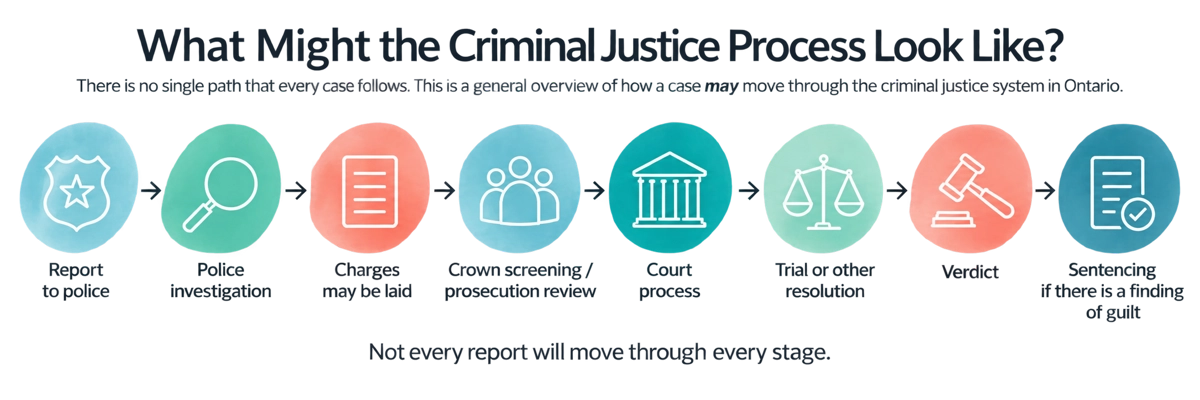
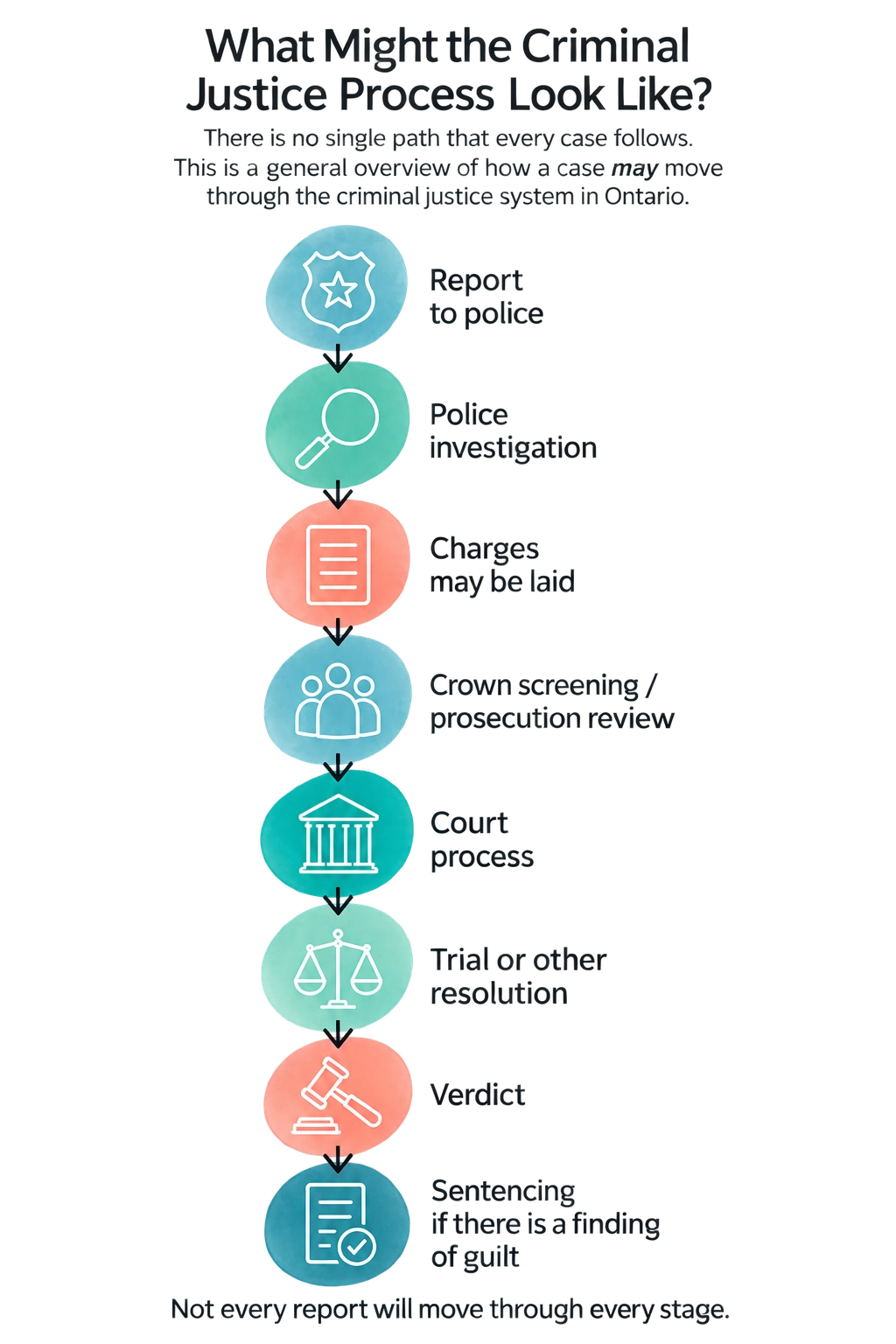
Police may interview the child, speak with witnesses and gather relevant records or other evidence. If charges proceed, there may be several court appearances before the case is resolved.
At trial, the Crown must prove the charge beyond a reasonable doubt. Children and young people may be eligible for testimonial aids or other measures to support them through the court process.
An investigation or prosecution ending does not determine whether a child was truthful or change the importance of supporting their safety and recovery.
What the Canadian Data Tells Us
Ontario-specific data tracking childhood sexual assault cases through every stage of the justice system—from report to charge to conviction—is not routinely published. Statistics Canada also does not publish a separate national conviction pathway exclusively for childhood sexual abuse. The best available national evidence therefore comes from broader sexual-assault data. Childhood sexual abuse cases can face additional investigative and evidentiary challenges, including:
delayed disclosure (often years after the abuse),
evidentiary challenges,
lack of corroborating physical evidence,
reliance on victim testimony,
offences occurring in private settings,
family or caregiver involvement,
developmental and communication factors that can affect how children's evidence is obtained and presented
Earlier Statistics Canada analyses found that sexual assaults against children committed by a parent or step-parent were among the least likely cases to result in conviction after being reported to police Statistics Canada — From arrest to conviction: Court case outcomes of police-reported sexual assaults in Canada, 2009 to 2014
While conviction data has not yet been updated beyond the 2015–2019 cohort, Statistics Canada has released newer information on reporting and police-reported incidents.
Some notable updates include:
Police-reported sexual assaults have continued to increase across Canada through 2023.
The 2025 Survey of Safety in Public and Private Spaces found that 8.6% of victims of sexual assault said their most serious incident was reported to police, up from 4.3% in the comparable 2018 survey. Sexual assault nevertheless remained substantially underreported to police.
Research shows substantial attrition between a sexual assault being reported to police and a case resulting in a finding of guilt. Delayed disclosure can create additional investigative and evidentiary challenges, particularly when abuse is reported years or decades later.
The most recent Statistics Canada analysis tracking sexual assault cases from police through completed court outcomes was published in 2024 and examined cases reported between 2015 and 2019.
Between 2015 and 2019, Canadian police reported:
115,859 sexual assaults
about 36% resulted in charges being laid or recommended
of the incidents where charges were laid or recommended, 61% were linked to a completed court case
Once cases reached court, about 48% resulted in a finding of guilt
Why Childhood Sexual Abuse Cases Can Face Additional Barriers
Although Statistics Canada does not publish a conviction rate exclusively for child sexual abuse cases, Canadian research identifies several factors that reduce the likelihood of a conviction.
Delayed Disclosure
Perhaps the most important finding is that delayed disclosure is the norm rather than the exception.
Research by Canadian scholars Ramona Alaggia and Delphine Collin-Vézina found that children commonly:
delay disclosure for months, years, or decades;
disclose gradually rather than all at once;
initially deny or partially disclose abuse;
recant because of fear or family pressure.
Reasons include:
fear of not being believed;
shame and self-blame;
threats by the offender;
loyalty toward a parent or trusted adult;
fear of breaking up the family;
developmental limitations in understanding the abuse.
Importantly, the Canadian Department of Justice emphasizes that delayed disclosure should not be interpreted as evidence that an allegation is false.
Lack of Physical Evidence
When abuse is disclosed years later:
DNA or other forensic evidence may no longer be available.
medical findings are uncommon.
independent witnesses may not exist or may be difficult to identify.
memories of dates and locations may be incomplete.
Consequently, many prosecutions rely almost entirely on witness testimony.
Abuse Usually Occurs in Private
Research consistently shows child sexual abuse most often occurs:
in private residences
without eyewitnesses
by someone known to the child.
This creates evidentiary challenges because the case often depends on assessing credibility.
The Offender is Frequently Someone the Child Knows
Many offenders are:
parents
step-parents
relatives
family friends
coaches
teachers
trusted adults
Children abused by someone they trust are significantly more likely to delay disclosure.
Ontario Crown Policy
Ontario's Crown Prosecution Manual recognizes the unique challenges in child abuse prosecutions.
Ontario Crown policy directs prosecutors to:
use testimonial aids whenever appropriate
engage victim support services
seek independent legal advice for victims regarding records
avoid withdrawing or reducing sexual abuse charges without senior Crown approval
avoid resolving child sexual abuse prosecutions by pleading to non-sexual offences unless exceptional circumstances exist.
These policies reflect recognition that offences against children require specialized handling.
Canadian Research on Delayed Prosecution
One particularly relevant Canadian study analyzed 4,237 cases of child sexual abuse heard in Canadian criminal courts. Factors Associated with Delays of Days to Decades to Criminal Prosecutions of Child Sexual Abuse
The researchers concluded:
delayed prosecutions are common;
delays of years or decades are expected in many child sexual abuse cases;
abuse by trusted adults often results in the longest reporting delays;
longer abuse duration was associated with longer delays before criminal prosecution.
Recent Evidence (2026)
A 2026 study of 204 child sexual abuse cases concluded in Poland between 2017 and 2023 found that delayed reporting did not significantly reduce the likelihood of conviction once a case entered the justice system.
Instead, the strongest predictors of conviction were:
the thoroughness of the police investigation, and
the victim's age at the onset of abuse.
The findings suggest that investigative thoroughness may be an important factor in legal outcomes, even in cases involving delayed disclosure.
Deciding Whether to File a Police Report
This is a deeply personal and often difficult decision and separate from any legal duty to report a child-protection concern. (In Ontario, certain concerns about a child under 16 must be reported directly to a children's aid society - Do I Need To Report This?
Sentencing
If a person pleads guilty or is found guilty, the court determines the sentence. Depending on the offence and circumstances, a sentence may include imprisonment, probation, a conditional sentence where legally available, or other orders.
A person serving a custodial sentence may later become eligible for forms of conditional release, including parole. Parole does not end or shorten the sentence; it allows part of the sentence to be served in the community under supervision and conditions.
When an offender is serving a sentence in the community under probation or parole, they are supervised by a probation or parole officer and must comply with court-ordered or release conditions. These conditions may include restrictions on contacting the victim and can include movement or location restrictions. Victims may receive information about an offender's status or release, and victim safety concerns can be considered in the supervision process. For some survivors, knowing that an offender is subject to ongoing supervision and monitoring may provide an added sense of reassurance.
Every survivor's journey is different. While the criminal justice system is one avenue toward accountability, many survivors also find healing through counselling, community support, restorative practices, and reclaiming control over their own recovery.

The Essentials
There is no single path every case will follow.
Not every police investigation results in charges or a trial.
A case ending does not determine whether your child was telling the truth.
Delays, limited physical evidence and delayed disclosure are common challenges in CSA cases.
Whatever happens in the justice system, your child’s safety, support and healing still matter.
Additional Reading & Listening
Children and the Justice System in Canada: Developmental Considerations for Enhancing Evidence
Department of Justice Canada
An accessible overview of what research tells us about children participating in the justice system, including testimony, questioning and supports that can reduce stress.
Read: Children and the Justice System in Canada
Criminal Justice Outcomes of Sexual Assault in Canada, 2015 to 2019
Statistics Canada
A detailed look at what happens to police-reported sexual assault cases as they move from police investigation through charges, court and sentencing.
Read: Criminal Justice Outcomes of Sexual Assault in Canada
Sexual Assault Incidents in Canada: From the Police to Criminal Courts
Statistics Canada
A visual, plain-language infographic showing how reported sexual assault cases move through different stages of the Canadian criminal justice system.
Explore: Sexual Assault Incidents in Canada
Testimonial Aids for Young Victims and Witnesses
Department of Justice Canada
A practical explanation of supports that may help children and youth give evidence, including support people, screens and testifying outside the courtroom.
Read: Testimonial Aids for Young Victims and Witnesses